|
Vietnam Neurological Association Vietnamese Journal of Neurology |
Address: Neurology Center, Bach Mai Hospital 78 Giai Phong Road, Dong Da, Ha Noi Email: [email protected] |
UNIFORM REQUIREMENTS FOR JOURNALS SUBMITTED TO
VIETNAMESE JOURNAL OF NEUROLOGY
(Effective from January 2024)
The Vietnamese Journal of Neurology (ISSN: 2354-0931), publishing license number 290/GP-BTTTT dated August 15, 2023, is the official scientific publication of the Vietnam Neurological Association. The journal is published on a quarterly basis, with one annual issue available in English.
The Vietnamese Journal of Neurology will consider and publish submissions on issues relevant to neurology and related specialties. The journal's purpose is to provide readers with significant research, insightful articles, clinical case studies, and new perspectives pertinent to the practice of neurology.
Authors submitting articles to the Vietnamese Journal of Neurology must disclose any sources of funding for their research (if applicable). The editorial board should be informed of any other organizations that may have a potential dispute over copyright (such as co-ownership, consultancy, etc.).
Articles will be evaluated by two or more editors. Articles are accepted based on content, creativity, and value. If accepted for publication, the editors may edit the article to enhance clarity and readability without changing the meaning of the article.
The journal will include the following sections: Research Articles, Clinical Case Reports, Review Articles, and Special Articles.
- PUBLISHING AND REVIEW PROCESS
The publishing process for the Vietnamese Journal of Neurology includes:
1.1. Submission of Manuscripts
Receive manuscripts via:
Authors can submit manuscripts via the journal's online software (https://vjn.vnna.org.vn/) or send them to email [email protected].
1.2. Screening
- The editorial secretary will screen submissions to ensure compliance with the journal’s guidelines on scope, topic, format/structure, and research ethics (within 1 week).
- Notification of the manuscript status will include::
- Manuscript not accepted
- Manuscript requires revisions before peer review
- Manuscript will proceed to peer review
1.3. Peer review
- The Editor-in-Chief or Deputy Editor-in-Chief assigned by the Editor-in-Chief will identify appropriate experts to review each article.
- The secretary sends a letter to experts inviting them to review the manuscript.
- The secretary sends the manuscript and the manuscript review form to the experts who have agreed to review it.
- Each manuscript is sent to 02 independent reviewers (after removing information about the author). The content of the manuscript is kept confidential, the reviewers do not share information about the manuscript with anyone without the prior permission of the Editor-in-Chief.
- The reviewer will return the review to the Journal (Editor-in-Chief or Deputy Editor-in-Chief assigned by the Editor-in-Chief and secretary) within 2 weeks of receipt.
- Reviewers are encouraged to use standardized tools and guidelines widely adopted by the global scientific community, including:
- Consolidated Standards of Reporting Trials: CONSORT
- STrengthening the Reporting of OBservational studies in Epidemiology: STROBE
- Preferred Reporting Items for Systematic Reviews and Meta-analyses: PRISMA
- Case reports/Case series: CARE
- Other guidelines: See at https://www.equator-network.org/
- Reviewers evaluate the article according to the following aspects (not limited to these):
- Is the research topic important, novel, and of interest to the scientific community?
- Are the research objectives clearly defined?
- Is the research method scientific (ensures validity and reliability) and appropriate to achieve the research objectives?
- Are the research results clearly presented?
- Are the research results explained and discussed reasonably based on existing knowledge?
- Are the limitations and assumptions clearly presented?
- Are the conclusions and recommendations reasonable and based on the research results?
- Applicability of the research results?
- Other specific comments
- Conclusion on the manuscript according to one of the following situations: 1) Agree to publish, no editing required; 2) Agree to publish, need editing, no need for review; 3) Agree to publish, need editing, review; 4) Disagree to publish.
1.4. Handling peer review results
- The article is approved by two reviewers.
- The secretary informs the author of the reviewer's (anonymous) comments.
- The author revises the manuscript based on the comments of the two reviewers and returns the revised manuscript and feedback to the reviewer within 2 weeks.
- In case the author does not agree with the reviewer's opinion, the secretary shall report to the Editor-in-Chief for decision.
- The article is accepted by one reviewer and rejected by one reviewer.
- The secretary informs the author of the opinions of the two reviewers and sends the article to the third reviewer (ensuring anonymity).
- If the article is accepted for publication by the third reviewer, the same procedure is followed as for articles accepted by two reviewers.
- In case of different opinions from the reviewers, the secretary will report to the Editor-in-Chief for decision.
- The article is rejected by two reviewers
- The secretary informs the author the results and the article is not considered for publication.
1.5. Plagiarism checking
Manuscripts, after being approved by peer reviewers, will be checked for plagiarism using plagiarism-checking software. (using iThenticate).
Manuscripts with a similarity index exceeding 20% or with identical paragraphs of 100 words or more will be rejected from the publication process. In addition, the authors of the articles will be banned from further submissions to the Journal in future issues.
1.6. Technical editing
- Articles that have been approved by reviewers and completed by the author are technically edited and numbered. Numbering is done according to the following principles: According to the time the article was accepted for publication; According to groups of topics, content, and types of articles.
- The editorial secretary compiles the articles/images and forwards them to the design/layout team.
- The design/layout team will send the draft to the editorial secretary for review and editing.
- The editorial secretary submits the final proof to the Editor-in-Chief or the Deputy Editor-in-Chief assigned for approval.
1.7. Printing and Publication
- The final approval (the Editor-in-Chief or Deputy Editor-in-Chief assigned to approve) will be sent to the printer.
- Each issue of the journal will be printed in 100 copies, with each copy containing approximately 75-120 pages.
- The journal is published periodically with one issue every 1.5 months (8 issues per year, including 6 in Vietnamese and 2 in English).
Note: Authors may contact the journal to inquire about the status of their manuscript.
Process of peer review
1.8. General principle:
The Editor-in-Chief of the Editorial Board member is responsible for the peer review process. The secretary will then send the manuscript to reviewers via the online peer review system. Each manuscript is reviewed by 2 independent reviewers (after removing author information).
The content of the manuscript is kept confidential, and peer reviewers must not discuss it with anyone without prior permission from the Editor-in-Chief. Reviewers will submit their anonymized feedback after receiving the manuscript, following the peer review process.
Independent reviewers will evaluate the manuscript using a template that covers the following main issues: (Appendix 3. Manuscript Review Template)
- The importance of the research question;
- The originality of the research content;
- The strengths and weaknesses of the research design, data collection, and data analysis;
- The writing style, organization, and presentation of the data in the manuscript;
- The impact of the findings drawn and demonstrated.
For each research design and submission type, reviewers use the following internationally recognized quality improvement tools:
- CONSORT (Consolidated Standards of Reporting Trials) for clinical trials.
- STROBE (Strengthening the Reporting of Observational Studies in Epidemiology) for observational studies.
- PRISMA (Preferred Reporting Items for Systematic Reviews and Meta-Analyses) for systematic reviews and meta-analyses.
- CARE (Case Report Guidelines) for case reports.
- Other tools: See at https://www.equator-network.org/
1.9. Double-Blind Peer Review Process
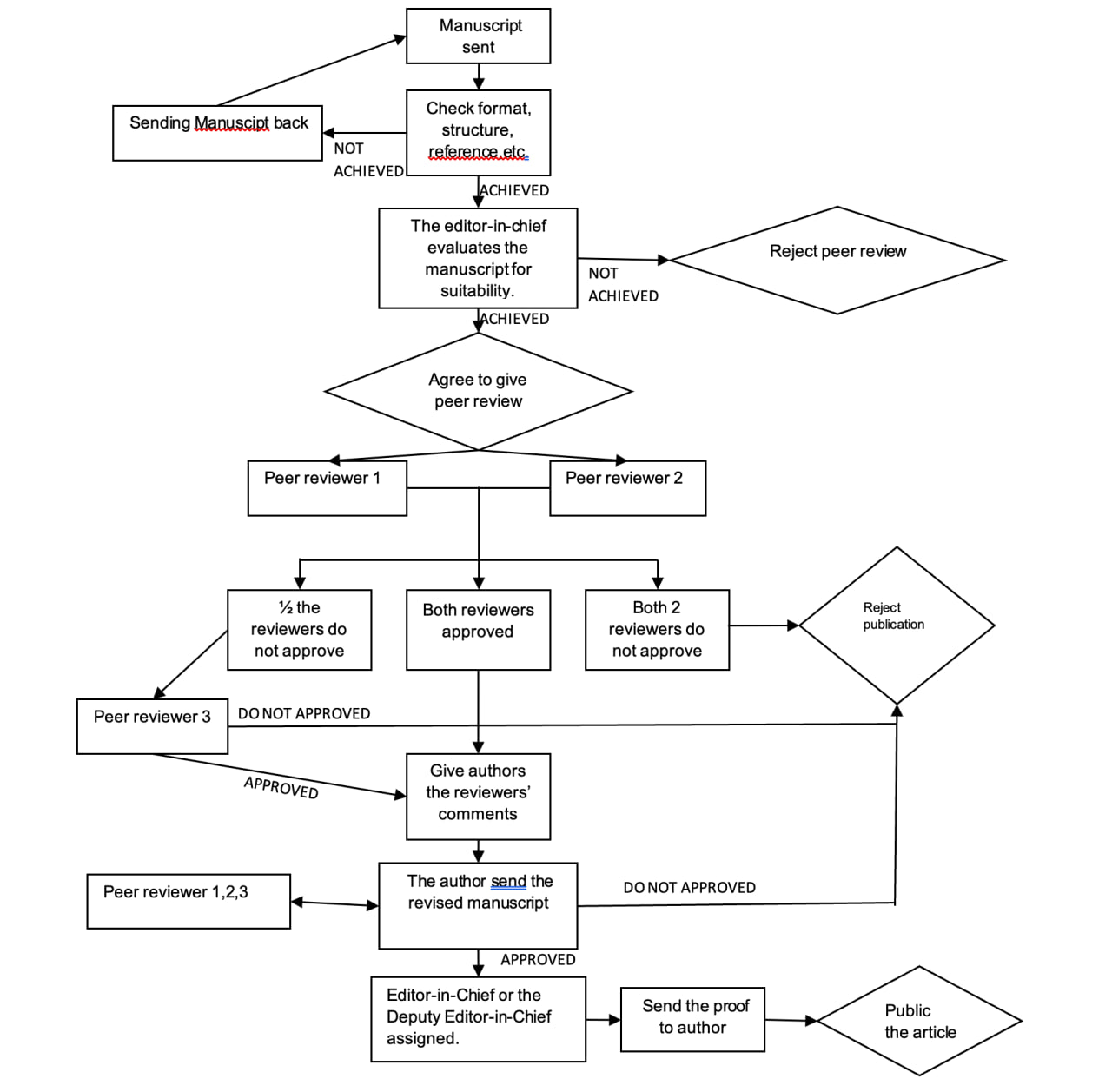
- The article is approved by two reviewers.
- The secretary informs the author of the reviewer's (anonymous) comments.
- The author revises the manuscript based on the comments of the two reviewers and returns the revised manuscript and feedback to the reviewer within 2 weeks.
- In case the author does not agree with the reviewer's opinion, the secretary shall report to the Editor-in-Chief for decision.
- The article is accepted by one reviewer and rejected by one reviewer.
- The secretary informs the author of the opinions of the two reviewers and sends the article to the third reviewer (ensuring anonymity).
- If the article is accepted for publication by the third reviewer, the same procedure is followed as for articles accepted by two reviewers.
- In case of different opinions from the reviewers, the secretary will report to the Editor-in-Chief for decision.
- The article is rejected by two reviewers
- The secretary informs the author the results and the article is not considered for publication.
II. General requirements
Requirements for manuscripts and authors
Works published in the Vietnamese Journal of Neurology must be original manuscripts published for the first time and have not been previously published in any publicly accessible journal or database.
Information about the authors should be presented in a separate file (completely distinct from the manuscript) and submitted along with the manuscript. If the manuscript has multiple authors, it is necessary to specify the corresponding author, co-authors, and the contact author according to the Journal’s guidelines. The first-listed author and the contact author are automatically considered the main authors. If the contact author is not the first-listed author, they should be placed last, preceded by the word “and” and symbolized by the symbol
Each author is allowed to be the first author of a maximum of 02 (two) works in one issue. The author is responsible to the public and relevant regulations of Vietnam for the contents of the manuscript. The author must submit a commitment signed by the main author (According to the form "Author's commitment").
Article manuscript file format
The manuscript is written in Vietnamese or English using Microsoft Word software (.doc or .docx file extensions), grammatically correct, no spelling errors. Formatted in A4 Times New Roman, the font size is 12 (Unicode font system), the line spacing is 1.5, the margin is Normal. Each article is not more than 4000 words, excluding tables, illustrations, and references. The manuscript must have clear page numbers, centered, at the bottom margin of the page.
Vietnamese terms are unified according to the Vietnamese Encyclopedia. Vietnamese nouns translated from foreign languages must be written with the original word. Limit the use of abbreviations. If abbreviations are unavoidable, they must be defined at their first occurrence in the manuscript.
Figures, tables, and charts presented in other formats (.jpg, .pdf, etc.) are sent as original files with figure captions.
Tables, figures, and their captions should be placed in the correct positions within the manuscript and numbered in the order they appear in the text.
Reference format
References are cited in the order in which they appear in the text, not by author or year.
References are numbered and presented according to AMA regulations (available at: https://libguides.usc.edu/ld.php?content_id=49818556). For Vietnamese authors, the full name must be given.
III. ETHICAL REQUIREMENTS FOR MANUSCRIPTS
A manuscript will only be accepted if the corresponding author commits to the following:
- The content of the manuscript has not been published in whole or in part in any other journals;;
- The manuscript has not been published elsewhere;
- All authors have made significant contributions to the research or preparation of the manuscript and share responsibility for its content;
- Compliance with research ethics standards (e.g., obtaining consent to participate in the study) and the research has been approved by a reputable Biomedical Research Ethics Committee
Additionally, authors must disclose in the manuscript (in the Acknowledgments section) any research funding sources, the role of pharmaceutical companies, medical device companies, and other entities in supporting the research, and any potential conflicts of interest related to the research.
IV. SPECIFIC GUIDELINES FOR AUTHORS SUBMITTING TO THE VIETNAMESE JOURNAL OF NEUROLOGY
TITLE OF THE ARTICLE
(The title of the article should be short, maximum 20 words, written in capital letters but showing the main content of the article, avoiding abbreviations and presented in Vietnamese and English)
Author’s name and institution
Author A1, Author B2 and Author C3
- Author order: arranged in descending order of contribution, separated by commas. The first author and the corresponding author are defaulted as the main author.
1Institution X, 2 Institution Y, 3 Institution Z. In cases where all authors are from the same institution, numbering is not required. The institution is translated into both Vietnamese and English.
The corresponding author. If the corresponding author is not the first author, they should be listed last. Note (): the corresponding author, provide the address and email (This information should be placed in the footer of the first page) (Vietnamese and English).
V. SPECIFIC GUIDELINES/REQUIREMENTS FOR EACH TYPE OF ARTICLE IN THE VIETNAMESE JOURNAL OF NEUROLOGY
Authors can download and refer to the general article format
RESEARCH ARTICLE
Length does not exceed 4,000 words (about 10 standard pages) including tables and figures (no more than 6 tables and figures), references, and abstract in Vietnamese and English.
RESEARCH ARTICLE FORMAT:
TITLE OF THE ARTICLE
(The title of the article should be short, maximum 20 words, but show the main content of the article, avoid abbreviations, and should be presented in Vietnamese and English, capitalized and bold).
Author’s name and institution: Write author(s)’s full name, and institution, do not include titles or academic degrees.
Abstract: structure includes 1) Objectives, 2) Study design; 3) Location and time of study, 4) Participants; 5) Results, 6) Conclusion. The summary should present the main results and conclusions of the work. The abstract is presented as a single paragraph, without separate sections, and does not exceed 250 words.
Keys: 3-6 keywords or phrases. Use short, representative terms that are directly related to the main content of the article.
Abbreviations (if any): Provide explanations in the list and define abbreviations when they first appear in the text.
ABSTRACT (Applicable only to articles written in Vietnamese)
The English title of the article is written in uppercase letters and translated from the original Vietnamese title. The English abstract (not exceeding 200 words) is translated from the Vietnamese abstract, including keywords.
- INTRODUCTION
Introduce the reason for conducting the research in relation to previous studies done both domestically and internationally. Based on this, clearly state the specific, relevant, and feasible objectives.
- STUDY DESIGN AND PARTICIPANTS
Be brief but provide enough information for the reader to understand the research process. Only new processes, implemented for the first time, should be described in detail, citing the source of reference for these research processes. This section includes 3 main parts as follows:
- Participants (groups of participants, inclusion criteria, exclusion criteria).
- Method (include study design, sampling and sample size, content research, variables, research procedure, data analysis, setting and time).
- Ethical consideration (nêu rõ các khía cạnh và cách thức đảm bảo đạo đức trong nghiên cứu. (specify the aspects and methods for ensuring ethical standards in the research. If the study has been approved by the Institutional Review Board (IRB), include the approval number and date of the ethical research approval).
- RESULT
Figures and tables are presented directly in this section, including titles and brief notes below. Figures and tables are numbered consecutively starting from number 1 in the order of appearance, presented clearly with comments and brief notes below. Do not present tables and charts that are too simple if they can be described in words or have too many rows and columns that are difficult to present within the Journal's page size. The total number of figures and tables is at least 3 and not more than 6 (for research works).
The results section is presented following the research questions/objectives and can be organized by subheadings.
- DISCUSSION
Discuss the results in relation to the research questions/objectives, focusing closely on the results presented and using relevant references to compare and explain the research findings. Discuss the limitations of the study and potential solutions. The discussion should be presented as a continuous paragraph without subheadings. Only address explanations related to the obtained results. Do not repeat the names of tables, figures, or research results
- CONCLUSION
Summarize the main research findings concisely and broadly. Do not repeat the data presented in the results section. No using bullet points or numbering for conclusions.
Acknowledgments (if any): Authors specify the research funding agency (if any) and declare no conflict of interest related to the research results. This section is placed before the References and does not need to be numbered.
REFERENCE
References is cited numerically, not by author name and year. Each article has maximum of 10 references, except for review articles. References is compiled and arranged in the order they are cited in the articles and must be cited within the article. References should be presented verbatim, without transliteration or translation. Limit the use of theses, textbooks, and websites as references.
Follow AMA citation guidelines and use reference management software such as Endnote or ZOTERO.
CASE STUDY REPORT
Length does not exceed 3.000 words (about 8 standard pages) including tables, charts, illustrations, and references (no more than 6 tables and figures). Abbreviations are noted in parentheses.
CASE STUDY REPORT FORMAT:
TITLE OF THE ARTICLE
(The title of the article should be short, maximum 20 words, but show the main content of the article, avoid abbreviations, and be presented in Vietnamese and English. Mention symptoms/syndromes, diagnosis, treatment and include the phrase “Case Report”).
Author’s name and institution: The main participants’ names in the article must be included in the list of authors. Write the full names of the authors in Vietnamese’ way. The order of the authors should be agreed upon among the authors according to their contribution to the article, the addresses of the authors' institution (do not include titles or academic degrees), and the e-mail and contact phone number of the main author.
Abtract: The summary should present the context in which the case was discovered, diagnosis, management, and outcome. The summary is presented in one paragraph and does not exceed 250 words.
Key: Use short, representative terms that are directly related to the main content of the article, maximum 6 words or phrases
ABSTRACT (Applicable only to articles written in Vietnamese)
The English title of the article is written in uppercase letters and translated from the original Vietnamese title. The English abstract (not exceeding 200 words) is translated from the Vietnamese abstract, including keywords.
- INTRODUCTION
- What is the research problem
- Present the results from 1-2 relevant references (if any)
- The importance of this case report
- Objective of the report
- Present the application of international standards (CARE)
- PRESENT CASE STUDY
Need to ensure the following content and information:
- General information
- Demographic information: Age, gender, ethnicity, occupation, place of residence, economic conditions, etc.
- Main symptom
- Personal and family history (if any).
- Clinical features
- Disease progression over time
- Diagnosis
- Diagnosis method
- Difficulties in diagnosing
- Diagnostic results
- Treatment
- Treatment method
- Treatment order
- Treatment change (if any)
- Treatment result
- Clinical Clinician and patient-assessed outcomes)
- Paraclinical (Important follow-up test results (positive or negative)
- Treatment adherence (Intervention adherence)
(Adverse and unanticipated events)
- DISCUSSION
- Weaknesses and Strengths
- The "rarity" and "uniqueness" of this case
- Compare with the medical literature
- Possible hypotheses to explain the results
- CONCLUSION
The main conclusions drawn from the case should be clearly stated, explaining the importance and extent of the impact, highlighting the contributions to medicine, and provide a foundation for future medical research/advancements.
Acknowledgment (if any)
Authors specify the research funding agency (if any) and declare no conflict of interest related to the research results. This section is placed before the References and does not need to be numbered.
REFERENCES
According to the guidelines for presenting a manuscript of a research article
SUMMARY (Applicable only to articles written in Vietnamese): The English title of the article is written in uppercase letters and translated from the original Vietnamese title. The English abstract (not exceeding 200 words) is translated from the Vietnamese abstract, including keywords.
TABLE, CHART, IMAGE: According to the guidelines for presenting a manuscript of a research article
REVIEW ARTICLE
Length does not exceed 4.000 words (about 10 standard pages) including tables, charts, and references, and abstracts in Vietnamese and English.
REVIEW ARTICLE FORMAT
TITLE OF THE ARTICLE
(The title of the article should be short, maximum 20 words, but show the main content of the article, avoid abbreviations, and be presented in Vietnamese and English).
Authors’ names, institutions: Write the author(s)’s full name, email, and institution, do not include titles or academic degrees.
Abstract: Write a structured summary, including sections such as 1) Objective, 2) Finding methods and Literature review, 3) Result, 4) Conclusion (maximum 250 words)..
Keys: 3-6 keywords or phrases. Use short, representative terms that are directly related to the main content of the article.
ABSTRACT (Applicable only to articles written in Vietnamese)
The English title of the article is written in uppercase letters and translated from the original Vietnamese title. The English abstract (not exceeding 200 words) is translated from the Vietnamese abstract, including keywords.
- INTRODUCTION
Clearly state the overview issue and the reasons for conducting the research review, the significance of reviewing the research topic, and the author's perspective and approach when reviewing the topic.
- METHOD
Include the methods for searching for literature, sources of literature, keywords, criteria for including and excluding literature, and the review methods...
- RESULT
Trình bày kết quả tìm kiếm, tóm tắt thông tin về các bài báo được đưa vào tổng quan và các kết quả tổng quan (theo mục tiêu).
Present the search results, summarize information about the articles included in the review, and the overall findings (according to the objectives)
- DISCUSSION: Discuss the finding results, knowledge gained from the review and the gaps that the overview results have not addressed...
- CONCLUSIONS
Clearly state what information the review has provided, whether it has achieved the stated objectives of the review, and present the prospects for further research on that topic.
Acknowledgment (if any)
Authors specify the research funding agency (if any) and declare no conflict of interest related to the research results. This section is placed before the References and does not need to be numbered.
REFERENCES
According to the guidelines for presenting a manuscript of a research article
OTHER ARTICLES
Length does not exceed 4.000 words (about 10 standard pages) including tables, charts, and references, and abstracts in Vietnamese and English.
- Format for other articles:
- Title (Vietnamese): write in lowercase, bold.
- Authors’ names, institutions: Write author(s)’s full name and email, do not include titles or academic degrees.
- Abstract: Write a structured summary, including sections such as 1) Objective, 2) Finding methods and Literature review, 3) Result, 4) Conclusion (maximum 250 words).
- Keys: 3-6 keywords or phrases. Use short, representative terms that are directly related to the main content of the article.
- Introduction: including the reasons and objectives
- Main content: flexible according to the type of article
- Conclusion: summarize the results of the article
- Acknowledgment: Thank the individuals, teams, researches, agencies, and/or organizations that supported the completion of this article.
- Title, authors and addresses, brief in English
- References: See the detailed guidelines above
Contact information:
VIETNAMESE JOURNAL OF NEUROLOGY OFFICE
Neurology Center – Bach Mai Hospital; 78 Giai Phong, Dong Da, Ha Noi
Email: [email protected] Website: https://vjn.vnna.org.vn/